How to Use ChatGPT for Google Ads: Part 1
TL;DR
Part 1 of this series shows how to put ChatGPT to work on the research half of Google Ads. Use it to draft buyer personas with demographics, pain points, and motivations, brainstorm long-tail keyword ideas, and run competitor analysis including a SWOT of their messaging. The catch: ChatGPT has no search-volume data, so validate keywords in Google Keyword Planner, Ahrefs, or Semrush, and edit every output to match your brand voice.
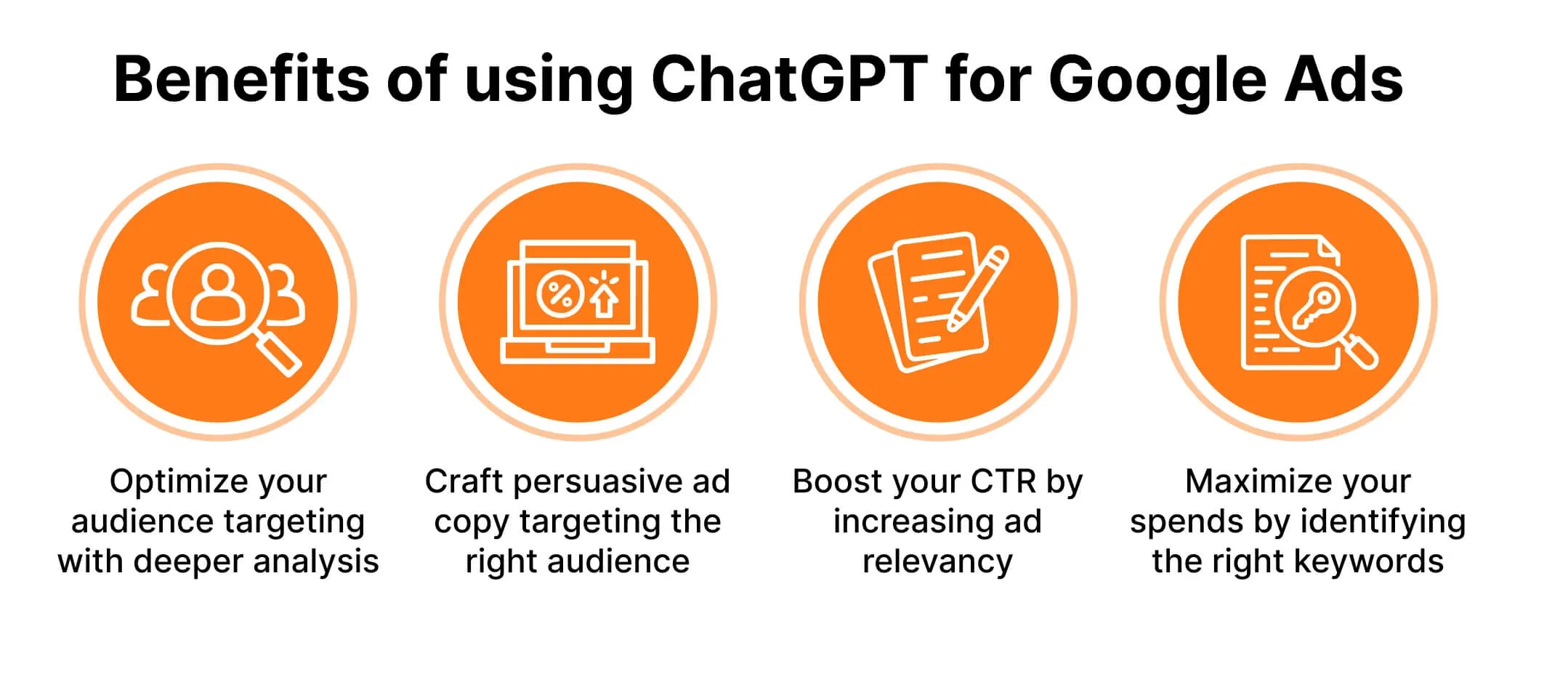
In 2019, JP Morgan Chase announced a 5-year partnership with Persado - a leader in AI-driven marketing creative solutions - in a bid to increase its AI-powered marketing capabilities. Why? In its pilot run, Chase saw a 450% increase in click-through rates on ads crafted by the AI tool. A clear indication that AI tools can make a difference in marketing strategies. This received a significant boost with the introduction of advanced AI tools like ChatGPT, which can significantly improve your Google Ads campaign performance and streamline your workflows to increase ROI. With appropriate ChatGPT prompts, you can ask it to handle a range of tasks, from research and writing to analysis and reporting. These tasks, which would typically take hours, can be automated and completed in minutes with ChatGPT.
How to use ChatGPT for research?
1. Understanding the Audience/Buyer Persona and Challenges
Understanding your audience not only provides valuable insights into their motivations but also helps the AI generate more relevant ad copy. As you gather insights, you're simultaneously training ChatGPT with an understanding of your audience and campaign objectives, enabling the creation of more nuanced prompts in the process. This results in better and more accurate responses, uncovering opportunities you may not have even been aware of. How ChatGPT can help: ChatGPT can assist in brainstorming and refining buyer personas by analyzing various sources - both internal and external. It can generate informed persona drafts covering demographics, interests, pain points, and behaviors. Additionally, it highlights any potential audience-challenges, allowing the integration of solutions into your ad copy. Prompt examples:
- Based on a target audience of [specific demographic, e.g., young professionals aged 25-35 interested in sustainable fashion], can you help me define a detailed buyer persona, including their potential challenges and pain points?
- Building on the previously defined persona, what could be their primary motivations when searching for [specific product/service, e.g., sustainable fashion brands], and how do they typically engage with online ads?
2. Keyword Research
Keyword research for Adwords is not the same as research for SEO. In Adwords, keywords can make or break your budget, it is the cornerstone of Google Ads’ success. With in-depth research, you can select keywords strategically, ensuring your ads are shown to the most relevant audience while maximizing Click-Through Rates (CTRs), engagement ratio, and conversions. Identifying high-performing keywords also helps reduce Ad-spend waste and boosts the campaign's overall performance. How ChatGPT can help: ChatGPT plugins like SEO Core AI or SEO Assistant can aid in brainstorming keyword ideas, especially long-tail or niche keywords. It can also interpret keyword data, suggesting potential areas of focus or optimization, provide insights into keyword competition, and recommend adjustments to maintain optimal campaign performance. Prompt examples:
- Given our target audience of [previously defined persona], what are some potential long-tail keywords they might use when searching online?
- Considering the motivations and challenges of our target audience, can you suggest additional search term variations that align with their specific needs and preferences?
3. Competitor Analysis
Analyzing competitors involves reviewing their ad strategies, keywords, ad copy, and landing pages. By dissecting these, you gain intelligence into what works and what doesn't. This empowers you to refine your strategy, craft more compelling ad copy, and match your campaign objectives with your audience’s needs. How ChatGPT can help: ChatGPT, with its powerful analyzing and computing power, can be a formidable ally in competitor analysis. It can spot tiny changes in messaging and trends, providing a critical analysis across all digital assets of your competitors. It can even summarize and create a SWOT analysis of their approach. Furthermore, it can continuously monitor your competitors and alert you when a change is detected. Prompt examples:
- Based on the keywords we've identified, can you help analyze how my competitors [insert competitor names] might be using these terms in their ads and what strategies they might be employing?
- Given the competitor strategies we've discussed, are there any emerging trends or insights in the [specific industry, e.g., 'sustainable fashion'] space that we should be aware of for our ad campaigns?

Best practices for using ChatGPT for Google Ads
Here are some details to keep in mind when creating a Google Ads campaign with ChatGPT:
- Align prompts with your objective: Always align the ChatGPT prompts and questions with your campaign objectives. Also, use the responses to enhance your knowledge - not replace your understanding.
- Quality control: While ChatGPT can quickly generate ad copy, it's important to review and edit the result. Ensure it aligns with your brand voice and meets quality standards. Combine ChatGPT's capabilities with human expertise and judgment for optimal results.
- Leverage other keyword research tools: ChatGPT can provide insights but it doesn’t have access to search volume and other key metrics. Consider using keyword tools like Google Keyword Planner, Ahrefs, or Semrush to gather additional data and validate your keyword list.
Using ChatGPT for Google Ads research and analysis can streamline tasks, provide fresh perspectives, and enhance the overall effectiveness of the campaign. Along with the above elements, you might want to analyze budget allocation strategies, look into geo-targeting, or explore remarketing strategies.
Check out our next article in the series, where we discuss the process of Google Ads copy creation.
Frequently Asked Questions
Can ChatGPT actually do keyword research for Google Ads?
It can brainstorm keyword ideas, especially long-tail and niche terms tied to a persona you have defined, and suggest search-term variations. But it has no access to live search volume, competition, or CPC data, so treat its output as a starting list. Validate everything in Google Keyword Planner, Ahrefs, or Semrush before you build a campaign around it.
Is keyword research for Google Ads the same as keyword research for SEO?
No. In Google Ads, keywords directly spend your budget, so they can make or break a campaign, whereas SEO keywords influence organic ranking over time. Ads research is about picking terms that reach the most relevant buyers and maximize click-through and conversions while cutting wasted spend. That commercial-intent focus is why the article treats it as the cornerstone of Google Ads success.
How do I use ChatGPT to build a buyer persona for my ad campaign?
Feed it a target audience (for example, young professionals aged 25 to 35 interested in sustainable fashion) and ask it to draft a detailed persona covering demographics, interests, pain points, and behaviors. Then build on that draft by asking about the persona's primary motivations and how they engage with online ads. Each prompt also trains ChatGPT on your audience, so later responses get more relevant.
Does AI-written ad copy really perform better?
It can. When JPMorgan Chase piloted Persado's AI copywriting, it saw as high as a 450% lift in click-through rates on AI-rendered ads, which led to a five-year deal announced in 2019. That is a best-case result from an enterprise tool, not a guarantee, but it shows AI-assisted copy can meaningfully move ad performance.
Should I trust ChatGPT's output without editing it?
No. The article is clear that you should review and edit every result so it matches your brand voice and quality bar, and use ChatGPT to enhance your understanding rather than replace it. Combine its speed with human expertise and judgment, and always align your prompts with the campaign's actual objective. Think of it as a fast research assistant, not the final decision-maker.
Sources
Keep reading
The archive →Chatbot Case Study: Purchasing a Chevrolet Tahoe for $1
Learn about prompt injection attacks and essential security measures for deploying AI chatbots, illustrated by the now-infamous $1 Chevrolet Tahoe incident.
AI PROMPTSStrategies for AI Success: Master the Art of AI Prompting in 2024
Become an AI prompting master: tailor persona, clarify tasks, formats, context, examples and sources. Enhance with simplicity, saving successful prompts and staying updated.
AI PROMPTS4 Ways Learning AI Prompting Helps to Improve Personal Productivity
Think AI is just for work? Think again. AI tools can become your secret weapon for a more productive and fulfilling personal life, once you learn to prompt them correctly.
From The Cut
All takes →- The Best Vector Databases in 2026: An Operator's Ranking
- The Honest AI Tool Stack for Startups in 2026
- Which Claude Model Should You Use in 2026? The Decision Tree
- AI API Pricing Comparison 2026: Claude vs OpenAI vs Gemini, By the Numbers
- Best AI Assistant in 2026: The Honest Operator Pick
- Best AI Chatbot in 2026: The Honest Operator Pick