Case Study - How Khan Academy Leveraged AI to Change Education
TL;DR
Khan Academy partnered with OpenAI and Microsoft to build Khanmigo, a GPT-4 powered tutor that uses the Socratic method to coach students through problems instead of handing them answers. It runs on natural language processing, role-plays historical figures, and cuts teacher prep time. After a 10,000-plus user US pilot, it now reaches every American educator, though it still stumbles on hard math, hallucinations, and bias.
Sal Khan, the founder of Khan Academy, had recognized that the one-size-fits-all approach in modern education lacked the necessary personalization that caters to an individual’s learning pace and style. Earlier technologies like chatbots and basic automations fell short of addressing these needs and Sal sought a solution that could fix this growing problem.
The advent of generative AI changed this.
Recognizing the potential that this new technology has in providing individualized education, Khan Academy reached out to Microsoft. The outcome was Khanmigo, an AI-powered tutor that was designed to offer personalized tutoring for free.
What is Khanmigo?
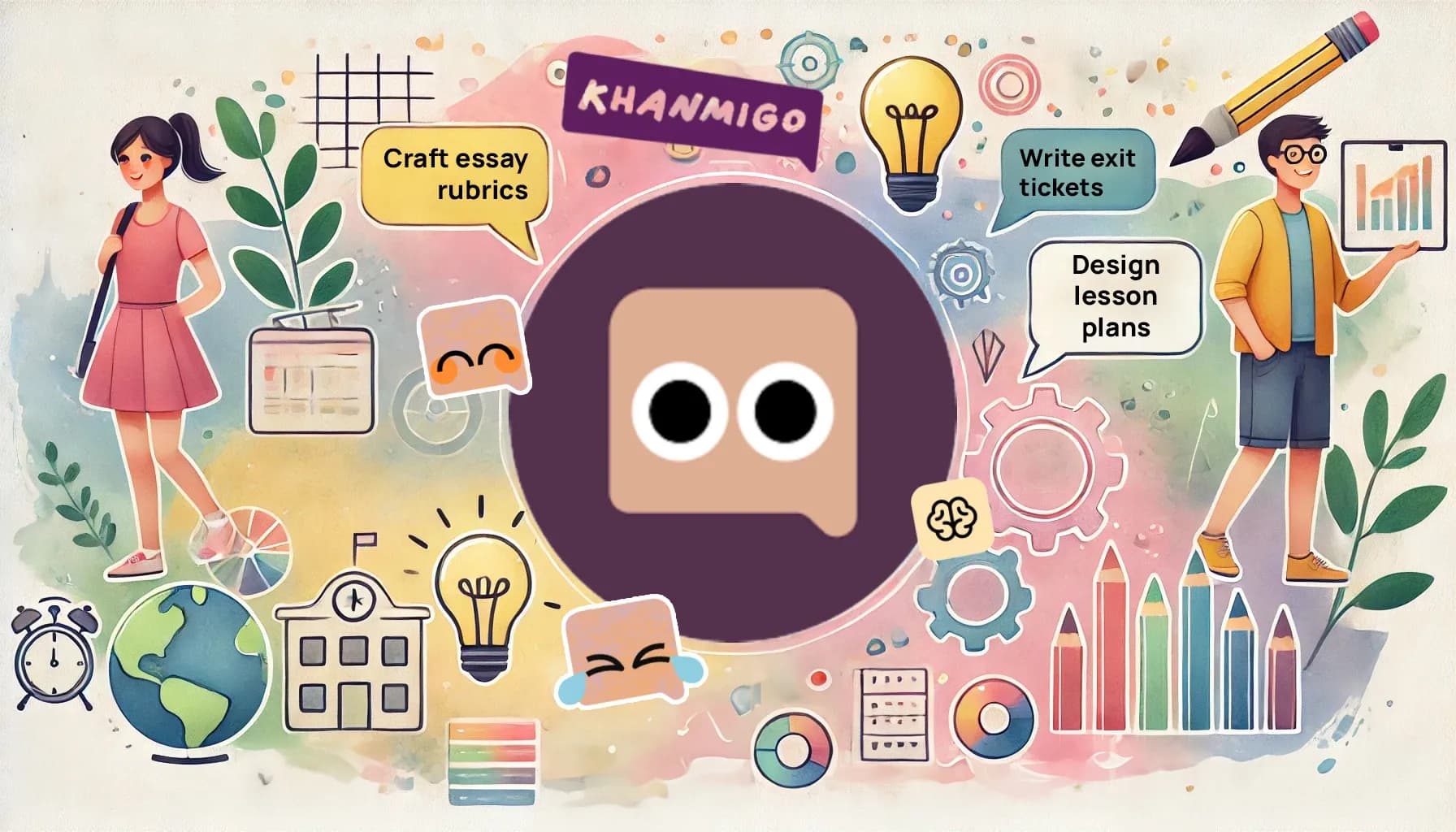
Khanmigo is an AI chatbot tutor, built on the GPT-4 architecture, designed to engage students in interactive learning sessions across a wide range of subjects. Unlike traditional educational technologies, Khanmigo uses the Socratic method to prompt critical thinking and independent problem-solving. Rather than simply providing answers, it encourages students to think deeply and reason through problems.
For instance, if a student asks for the solution to a math problem, Khanmigo responds with questions like, “What do you think the next step would be?” or “Can you explain your reasoning?”
How does Khanmigo work?
Khanmigo leverages natural language processing (NLP) to understand and respond to student queries in real-time. This technology enables Khanmigo to create interactive simulations and role-playing scenarios, providing practical, real-world learning experiences. For example, students can engage in conversations with historical figures like George Washington or literary characters like Winnie the Pooh, enriching their understanding of the subject matter.
Research conducted by Knewton also states that students leveraging adaptive learning programs were able to boost their test results by 62% comparatively.
Khanmigo combines contextual understanding with NLP to offer personalized student assistance through several steps -
- Tokenization - Breaking down the student's input into individual words or phrases.
- Semantic Analysis - Analyzing the meaning and relationships between the tokens to understand the context.
- Intent Recognition - Identifying the student's underlying intent, such as seeking clarification or requesting assistance.
- Response Generation - Generating an appropriate and relevant response based on the recognized intent and conversation context.
According to Allied Market Research, NLP in the education sector is projected to grow at a CAGR of 46.6%, highlighting the increasing importance of such technologies. The aim according to Sal Khan was to have a secure and supportive learning environment, especially for young users. To that point, they came up with specific features that might achieve that goal -
- Seamless Integration - Integrates with student assignments to provide real-time guidance and feedback.
- Engaging Conversations - Engages students in thought-provoking conversations to promote deeper understanding.
- Critical Thinking - Encourages productive struggle to develop critical thinking skills.
- Teacher Support - Reduces teacher workload by automating tasks like grading and providing personalized feedback.
- Progress Tracking - Tracks student progress to identify areas for support or enrichment.
- Robust Safety Measures - Khanmigo implements multi-layered safety measures like logging all interactions, guardian monitoring, and secondary AI monitoring.
Pilot run and future plans
To explore AI's potential further, Khan Academy launched a pilot program with select teachers, students, and donors through Khan Labs. This initiative aimed to deeply integrate and test Khanmigo in real educational settings, promoting productive struggle and engagement. Nearly 38% of tutors report that AI's most essential use case is generating lesson plans. The AI will assist in creating rubrics, developing prompts, and providing continuous feedback. Since its pilot launch, Khanmigo has been tested by over 10,000 users across the United States, with more than 8,000 teachers and students participating in classroom testing during the upcoming school year. The feedback mechanism has allowed for continuous improvement, ensuring the tool is refined based on real-world classroom requirements.
Khanmigo is now available to every single educator in the US, where it can potentially reduce preparation time by about 50%.
Challenges and limitations
While Khanmigo offers many innovative features, it also has its limitations -
- Complex Math Problems - The GPT-4 model struggles with complex math problems, leading to inaccurate results.
- Contextual Understanding - Sometimes misses the full context of a student's question, leading to unhelpful responses.
- Usage Limits - Usage limits can disrupt the learning process for students needing more time.
- Hallucination – AI tools are prone to fabricating information, which is risky in an educational setting. It’s important to keep a track of any potential lapses.
- Bias – AI tools are dependent on training data. If that training data has inherent biases, it can color the responses generated by the AI tool.
These issues can be frustrating for users and highlight the ongoing need for improvement.
Key takeaways for educators
The popularity of Khanmigo and the widespread interest has created a potential gateway for people in the education sector. Here are a few takeaways about the scope of AI in education -
- Personalized Learning - AI-driven tools can provide highly personalized learning experiences tailored to each student's unique needs and learning styles.
- Streamlining Teacher Workload - AI assistants can automate tasks like grading assignments and tracking student progress, freeing up valuable time for teachers to focus on other aspects of their role.
- Fostering Critical Thinking - While AI can handle many routine tasks, the integration of AI in education should aim to complement and enhance the role of teachers in fostering critical thinking, creativity, and collaboration among students.
- Addressing Challenges - Ensuring the accuracy and reliability of AI-generated responses, maintaining student privacy, and addressing issues of equity and accessibility are crucial considerations in the implementation of AI in education.
- Responsible and Ethical Implementation - Educational institutions and policymakers must work together to develop guidelines and best practices for the responsible and ethical integration of AI in the classroom.
- Balancing AI and Human Skills - As the adoption of AI in education continues to grow, it is crucial to prioritize the development of human skills alongside the integration of AI tools, ensuring a balanced and effective approach to teaching and learning.
Do you think Khanmigo's pilot will be a groundbreaking innovation in education or just another experiment that falls flat?
Sources
- Allied Market Research, Artificial Intelligence in Education Market (NLP segment fastest CAGR 46.6%, 2023–2032)
- CNN Business, “Meet Khan Academy's chatbot tutor” (Khanmigo pilot, 10,000+ users)
Frequently Asked Questions
What is Khanmigo and who built it?
Khanmigo is Khan Academy's AI tutor, built on OpenAI's GPT-4 architecture, with free teacher access supported through a Microsoft partnership. It offers personalized tutoring across math, humanities, coding, and more. Unlike a plain chatbot, it is wired into Khan Academy's existing content library.
How is Khanmigo different from just using ChatGPT?
Khanmigo leans on the Socratic method, so instead of spitting out the answer it asks questions like "What do you think the next step would be?" to make students reason it out themselves. It uses natural language processing to read intent and respond in real time. It can also role-play historical figures like George Washington or literary characters like Winnie the Pooh.
Does AI tutoring actually improve student outcomes?
The article cites research attributed to Knewton showing students using adaptive learning programs boosted test results by 62%. Khanmigo itself can potentially reduce teacher preparation time by roughly 50%. The wider promise is personalized instruction that adapts to each student's pace and style.
How many people have used Khanmigo and is it widely available?
Since its pilot launch through Khan Labs, Khanmigo has been tested by over 10,000 users across the United States, a figure CNN Business reported in August 2023. It is now available to every educator in the US. Thousands of teachers and students have joined classroom testing.
What are the limitations and risks of Khanmigo?
The GPT-4 model struggles with complex math problems and can return inaccurate results, and it sometimes misses the full context of a question. Like all AI tools, it is prone to hallucination, fabricating information, which is risky in a classroom. It can also inherit bias from its training data, which is why Khanmigo logs interactions and adds guardian and secondary-AI monitoring.
Keep reading
The archive →Generative AI Can Enhance the Quality of Professional Writing by 18%
A new study shows professional writers using ChatGPT improved writing quality by 18% and reduced writing time by 37%. Here is a detailed look at how AI can transform writing.
AI CONTENTCan AI-Generated Content be Trusted? Lessons from CNET's AI Debacle
CNET's AI-generated content controversy highlights the importance of factual accuracy and ethics. Brands need to be vigilant, establish clear AI policies, and maintain transparency.
AI CONTENTHow to use ChatGPT to Create a Content Marketing Strategy
A ChatGPT-driven blueprint for AI content marketing strategy.
From The Cut
All takes →- Best AI for Coding in 2026: The Honest Operator Ranking
- Best AI for Customer Support in 2026: The Operator Picks for Lean Teams
- Best AI for Data Analysis in 2026: The Operator Ranking
- Best AI for Marketing in 2026: The Operator Stack for Lean Teams
- Best AI for Research in 2026: The Honest Operator Ranking
- Best AI for Writing in 2026: The Honest Operator Ranking